

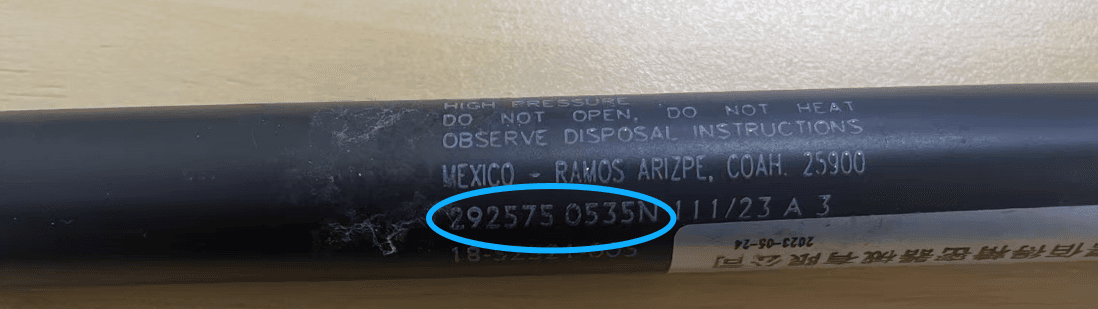
Gas spring grade for steel YQ10/22-170-604-700N
Understanding the Grade of Steel Gas Spring YQ10/22-170-604-700N: A Comprehensive Guid
If you’re working with industrial equipment, heavy furniture, or mechanical covers, you’ve likely come across gas springs. Among them, the steel gas spring YQ10/22-170-604-700N is a common choice for medium-to-high load scenarios. But what exactly defines its "grade"? Unlike a simple "grade" label on the product, its performance level is determined by a combination of model parameters and compliance with national standards (such as China’s GB/T 25751-2010 Compression Gas Spring Technical Specification). In this blog, we’ll break down its grade step by step, so you can clearly understand its application scope and performance limits.
1. First, Decode the Gas Spring Model: Key Parameters That Define the Grade
The model YQ10/22-170-604-700N isn’t just a random string of numbers—it’s a "performance ID card" for the gas spring. Each segment directly reflects its grade positioning:
| Model Segment | Parameter Name | Specification | Role in Defining Grade |
|---|---|---|---|
| YQ | Product Type | Compression Gas Spring | Confirms it’s a pressure-bearing gas spring (not tension or damping types), laying the foundation for grade classification. |
| 10/22 | Piston Rod Diameter / Cylinder Outer Diameter | 10mm (rod) / 22mm (cylinder) | Larger diameters mean higher load-bearing capacity and durability. A 22mm cylinder matches medium-to-high load requirements (vs. 18mm for light loads). |
| 170 | Stroke | 170mm | Determines the applicable scenario: 170mm is a medium stroke, suitable for equipment with moderate opening/closing distances (e.g., large cabinet doors, machine covers). |
| 604 | Extended Length | 604mm | The total length when fully extended, ensuring compatibility with the installation space of the equipment. |
| 700N | Nominal Force | 700 Newtons (≈71.4kg) | The core grade indicator! 700N falls into the medium-to-high load category, ruling out light-use scenarios (e.g., small furniture doors that only need 100-300N). |
Visual Tip: Imagine the gas spring as a "weightlifter"—the 700N nominal force is its maximum safe lifting capacity, and the 22mm cylinder is its "muscle size" that supports this capacity.
2. GB/T 25751-2010: The National Standard That "Grades" Performance
To truly understand the grade of YQ10/22-170-604-700N, we must refer to China’s mandatory standard for compression gas springs—GB/T 25751-2010. This standard sets strict thresholds for force accuracy, durability, and environmental resistance, which are the "hidden grade criteria" beyond the model.
2.1 Force Characteristics: The "Accuracy Grade" of Load-Bearing
According to Table 2 in GB/T 25751-2010, for a 700N nominal force gas spring (falling into the 601-800N range):
- Nominal Force Tolerance: ±25N (i.e., the actual force must be between 675N and 725N). If it’s outside this range, it’s a "substandard grade" and cannot be used for rated load scenarios.
- Maximum Dynamic Friction Force: ≤80N. Low friction means smooth operation—no jamming or sudden jumps when opening/closing, which is a key indicator of "high-grade" gas springs.
Example: If a YQ10/22-170-604-700N gas spring has an actual force of 730N, it exceeds the upper tolerance limit and fails to meet the standard’s "medium-to-high load accuracy grade."
2.2 Durability: The "Service Life Grade"
The standard classifies durability into two levels based on usage environment, directly affecting the gas spring’s "service life grade":
| Durability Test | Requirements for YQ10/22-170-604-700N | Grade Significance |
|---|---|---|
| Normal Temperature Cycle Life (6.5.1) | After 25,000 cycles, the nominal force attenuation ≤13%, and oil leakage <0.5g. | Meets the "industrial basic grade"—suitable for indoor, stable-temperature equipment (e.g., workshop cabinets). |
| Environmental Cycle Life (6.5.2) | After 1,000 low-temperature (-40℃) cycles + 1,000 high-temperature (80℃) cycles + 18,000 normal-temperature cycles, force attenuation ≤13%. | Meets the "harsh environment grade"—usable for outdoor or high/low-temperature scenarios (e.g., construction machinery covers). |
Key Note: Most YQ10/22-170-604-700N gas springs on the market comply with the normal temperature cycle life standard. If you need it for outdoor use, confirm with the manufacturer that it meets the environmental cycle life requirements—this is a critical distinction between "basic grade" and "enhanced grade."
2.3 Environmental Resistance: The "Adaptability Grade"
GB/T 25751-2010 also defines the gas spring’s ability to withstand extreme conditions, which is its "adaptability grade":
- High/Low Temperature Resistance (6.4): After 110℃ high-temperature storage + 2 cycles of -40℃/80℃, force attenuation ≤5%. This means YQ10/22-170-604-700N can work stably in most climates (excluding extreme environments like deserts or polar regions).
- Corrosion Resistance (6.7):
- The cylinder (painted) must pass a 96-hour neutral salt spray test without blistering or rust.
- The piston rod (hard chrome-plated) must pass a 48-hour neutral salt spray test. This ensures it won’t rust easily in humid environments (e.g., food processing workshops), meeting the "anti-corrosion grade" for industrial use.
3. Final Positioning: What Grade Is YQ10/22-170-604-700N?
Synthesizing the model parameters and GB/T 25751-2010 standards, we can clearly define its grade:
Grade Positioning: Industrial-grade medium-to-high load compression gas spring
Core Advantages: 700N load capacity + 22mm cylinder (high durability) + compliance with national standard force/temperature/corrosion requirements
Applicable Scenarios: Heavy equipment covers, large industrial cabinet doors, mechanical support structures (load 60-75kg, medium stroke)
Unsuitable Scenarios: Light loads (e.g., small furniture doors), extreme environments (e.g., -50℃ polar regions), or ultra-high load machinery (e.g., 100kg+ mechanical arms)
4. Practical Tips: How to Verify the Grade of Your YQ10/22-170-604-700N?
To avoid buying "fake high-grade" products, you can verify from three aspects:
- Check the Certificate: Ask the manufacturer for a test report complying with GB/T 25751-2010, focusing on force tolerance and cycle life data.
- Visual Inspection: The piston rod should be smooth (no scratches), and the cylinder paint should be uniform (no leakage)—these are basic signs of meeting the standard’s appearance grade (6.1.3-6.1.5).
- Simple Test: Manually push/pull the gas spring—there shoul be no obvious jamming, and the extension speed should be between 50-350mm/s (compliant with 6.3 of the standard).
Conclusion
The "grade" of YQ10/22-170-604-700N isn’t a single label but a comprehensive reflection of its nominal force, structural parameters, and compliance with national standards. By understanding these details, you can accurately match it to the right application scenario, avoid overloading or underutilizing, and ensure the safety and durability of your equipment.
If you have further questions—such as how to select gas springs for extreme environments or compare grades with international standards (e.g., ISO 11901)—feel free to leave a comment below!