
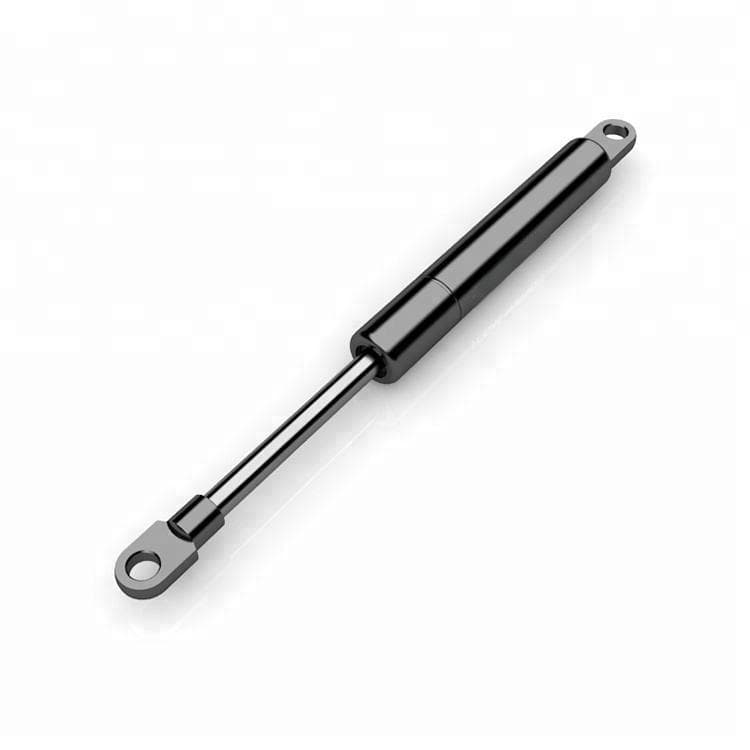
Compression Gas Spring (Gas Strut) - Technical Guide
Product Definition & Typical Applications
Compression Gas Spring (also known as Gas Strut, Gas Spring, Gas Lift, or Support Rod) is an industrial component that uses high-pressure inert gas (typically nitrogen) to provide controlled support, buffering, and lifting force. It's widely used in applications requiring precise, smooth motion control.
Core Function
Through compressed nitrogen, gas springs provide stable lifting force to assist in opening, supporting, and cushioning heavy components.
Typical Applications
- Automotive: Tailgate, engine hood, trunk lid
- Medical Devices: Maintenance covers, bed adjustment mechanisms
- Furniture: Flip-up doors, cabinet doors, height-adjustable tables
- Industrial Machinery: Equipment enclosures, maintenance covers, safety guards
Key Technical Specifications
| Parameter | Range | Description |
|---|---|---|
| Force (N) | 50 - 2,000 | Determines support capacity (~11-450 lbf) |
| Stroke (mm) | 30 - 700 | Piston rod extension distance |
| Full Length | Custom | Overall extended length (center-to-center) |
| Rod Diameter | 6 - 14 mm | Affects bending stiffness and sealing |
| Cylinder Diameter | 15 - 40 mm | Relates to internal gas volume |
Selection Guide
- Define application and required motion behavior
- Measure extended and compressed center-to-center lengths
- Determine target force based on load and geometry
- Choose end fittings compatible with mounting points
- Select options (damping, coating, corrosion resistance)
End Fittings
- Ball-joint sockets
- Eyelets and clevis
- Brackets and studs
Options
- Damping control
- Powder-coated cylinder
- Corrosion-resistant variants
Connection Types & Surface Treatments
Thread Connections
- M8×1
- M10×1
Ball Connections
- Ø10mm ball head
- Stainless steel ball socket
Special Connections
- Clevis fork ends
Surface Treatment
- Black electroplating
- QPQ nitriding
- Polished SS304/SS316
Quality Certifications
Standard Test Conditions
Test Speed
400 mm/min
Temperature
20°C
Four-Point Force Definition
Force at 10mm before full extension
Nominal lifting force (main selection criterion)
Force at 10mm before full compression
Extension start force
Force at 10mm after full extension
Compression start force
Force at 10mm before full compression
Maximum compression force
Key Performance Metrics
Friction Force
Fr = (F3 - F1) / 2
Progression Ratio
Fb / Fa
Industry Rule of Thumb
F1 : F4 ≈ 1 : 1.75
- Force calibration across full stroke
- Cycle endurance under load and temperature variation
- Damping consistency and oil leakage inspection
- Salt spray and corrosion resistance for coated parts
No domestic alternative
Solution: Drop-in replacement by diameter/force/connection
✓ Fast supply chain switch
Connection mismatch
Solution: M8→M10 adapters or custom redesign
✓ Flexible integration
Long lead times (8-12 weeks)
Solution: Compressed to 2-4 weeks
✓ Accelerated project timeline
High costs
Solution: 30%+ reduction via optimization
✓ Improved margins
Missing technical drawings
Solution: Sample measurement + CAD 3D
✓ Quick documentation
Incomplete certifications
Solution: One-stop RoHS, CE, ISO, SGS reports
✓ Market compliance
Automotive
Tailgate, hood, trunk—optimized force and stroke for smooth opening and safe hold.
Medical
Maintenance covers and patient bed mechanisms with low noise and stable damping.
Furniture
Cabinet doors and height-adjustable tables with controlled speed and safe stop.
Industrial
Enclosures, maintenance covers, and safety guards engineered for frequent operation.
Use our interactive selector tool to find the perfect gas spring specifications for your application.