
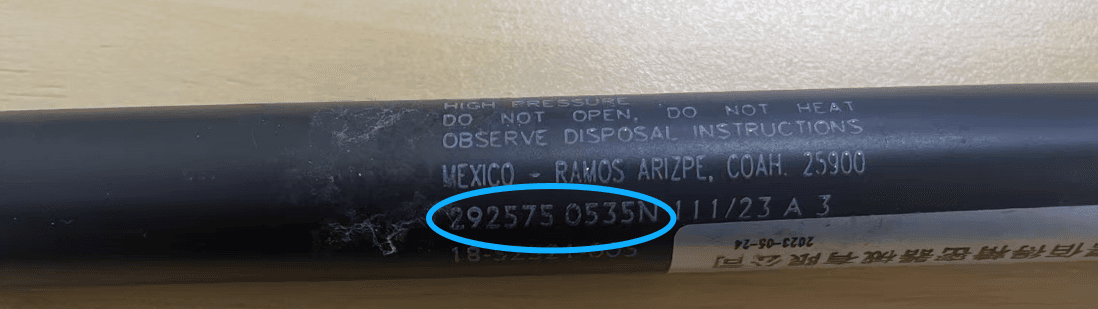
PN 292575 Gas Spring Replacement: The Stabilus Cross-Reference Case Study
PN 292575 Gas Spring Replacement: The Stabilus Cross-Reference Case Study
Not long ago, a customer sent us a single line: "Can you quote PN 292575?"
No brand name, no drawing, no specifications — just six digits and a question mark. This is the story of how we identified that part number, traced it back to a Stabilus Lift-O-Mat 752975, and matched it to a drop-in equivalent. If you keep reading, you will be able to repeat the exact same process with your own mystery numbers.
(Looking for the general step-by-step method instead? Read our companion article: How to Find the Right Replacement Gas Spring. This case study goes deeper into one specific number.)
What Is PN 292575? Decoding a Non-Standard Part Number
Here is the key insight from this case: PN 292575 is not a standard catalog number of any major manufacturer. It is a service/replacement designation that circulates in the aftermarket for a well-known original:
| Attribute | Value |
|---|---|
| Part number queried | PN 292575 |
| Original equivalent | Stabilus Lift-O-Mat 752975 |
| Force (F1) | 400 N |
| Cylinder diameter | 19 mm |
| Piston rod diameter | 8 mm |
| Total extended length | 585 mm |
| End fitting | 10 mm ball socket |
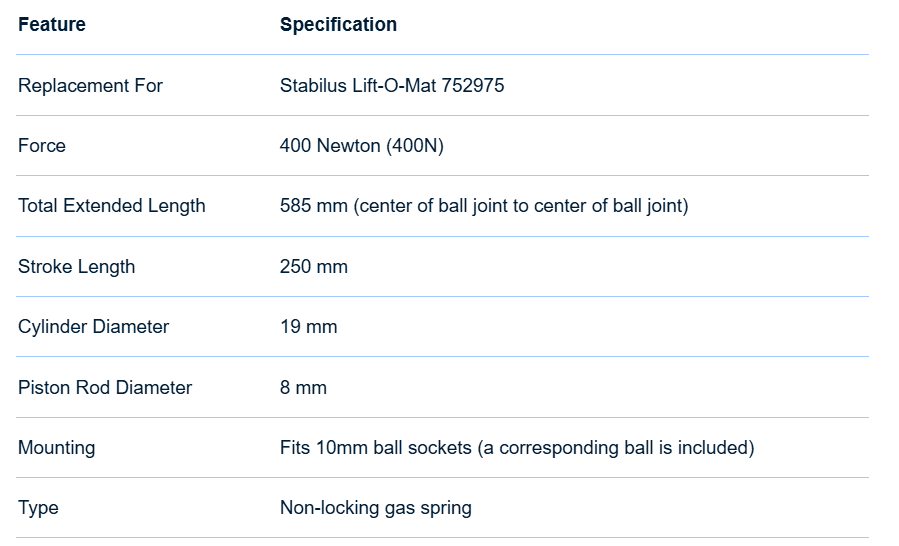
The "7xx xxx" family of Stabilus Lift-O-Mat numbers follows a recognizable logic — and once you know that 292575 is an aftermarket alias rather than an original factory code, the whole problem changes shape. You stop searching for "PN 292575" and start matching dimensions and force, which is what actually determines whether a replacement works.
How We Matched It: Dimensions First, Numbers Second
A gas spring physically interchangeable with PN 292575 must satisfy five constraints at once. Here is the checklist we applied, with the reasoning behind each row:
1. Extended length — 585 mm (center-to-center). Measured from the middle of one ball socket to the middle of the other, fully extended. This length sets the geometry of your lid or hatch: too short and the cover will not stay open; too long and it will not close.
2. Force — 400 N at F1. Force is printed on most original cylinders as a four-digit code plus "N". Matching within ±50 N is usually acceptable for lids under ~40 kg; beyond that, ask for an engineered recommendation.
3. Progression ratio — stroke vs. compressed length. Extended minus compressed length equals the available stroke. For this family, the compressed length is approximately 383 mm, giving roughly 200 mm of travel.
4. Diameters — 19/8 mm. Cylinder diameter affects rigidity and mounting clearance; rod diameter affects side-load robustness. Both must match your existing brackets.
5. End fittings — 10 mm ball sockets both ends. This is where many "close enough" replacements fail. The ball stud size on your bracket (here: 10 mm) dictates the socket, not the other way around.
The Result: A Verified Drop-In Replacement
Using the five constraints above, our engineering team confirmed a functionally identical substitute for PN 292575 — same extended length, same 400 N class, same 19/8 mm package, same 10 mm ball sockets. No re-drilling, no bracket changes, no adapter fittings.
That is the real value of a proper cross-reference: you order by verified dimensions, not by hope.
What If You Only Have Partial Information?
In real after-sales work you rarely get all five parameters. Here is how we prioritize when something is missing:
- Missing force? Estimate from lid weight × leverage, then verify on installation. We run free F1 calculations from a simple sketch.
- Missing compressed length? It can be derived from stroke charts once the series is known — but never guess it; a too-long unit cannot close.
- Unknown brand? Measure extended length + diameters + fitting size. Nine out of ten "mystery" struts are identifiable from those three numbers alone.
- Worn or unreadable label? Photograph the end fittings and the printing on the cylinder; manufacturing codes often survive better than labels.
Get Your Own Number Cross-Referenced
We maintain a growing cross-reference database covering Stabilus, SUSPA, Bansbach, AVM, JR Products and more, validated dimension-by-dimension by our engineers:
- Browse the brand replacement & cross-reference tool for common industrial codes
- Learn the full general method in How to Find the Right Replacement Gas Spring
- New to gas springs entirely? Start with the complete gas spring guide
Or simply send us your number, photo, or rough measurements through our contact form — PN 292575 took us one working day to verify. Yours will probably take less.
Authored by Ryan Chen, Senior Mechanical Engineer at DK Gas Spring, specializing in gas spring cross-referencing and custom OEM solutions.