

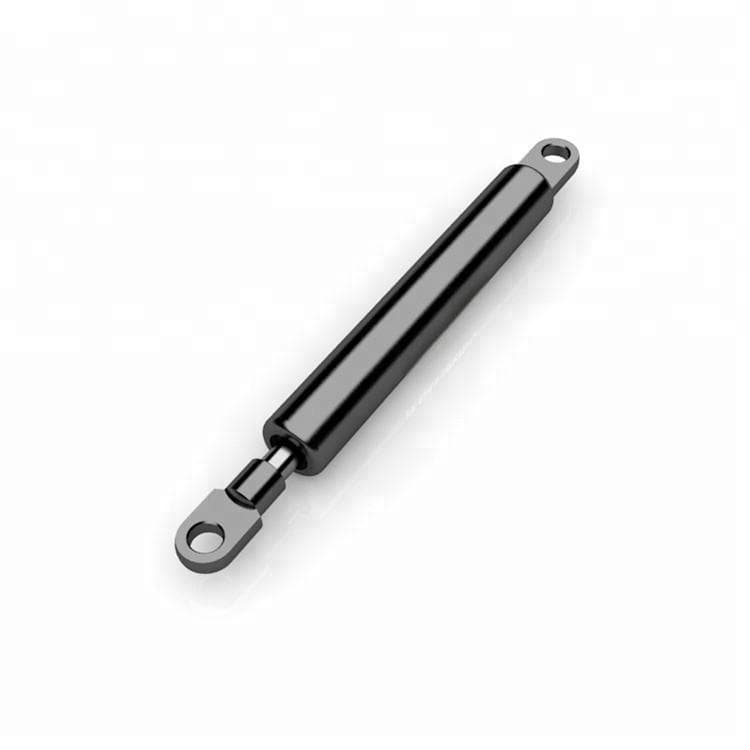
Tension Gas Spring Manufacturers | Pull-Type Gas Struts for Lids & Hatches
Discover the hidden force that pulls lids, hatches and guards back into place—smoothly, safely and without motors. Pull type tension gas springs are the ideal alternative for tight spaces and compact installations.
How it works (and why it’s different)
1. Free-state = Rod Retracted
2. Self-retracting Assist
Key Specifications Customers Ask For
- Force range 100-1 500 N (custom calibrations available)
- Closed length 200-450 mm; stroke 100-300 mm
- Single or double-tube design for different speed/curve behaviour
- End-fittings with safety locking pin or retention cable
- Annual volumes 500-5 000 pcs; quoted FOB Ningbo (or CIF/DAP by destination)
Where you’ll see it
Typical Applications
- Tractor engine hoods & side shields
- Sailboat hatches & storage lockers
- Automatic-retract safety guards
- Medical device lifting arms
- Industrial machine lids & access covers
Single-tube vs. Double-tube
Single: faster retraction, steeper force rise (indicative 100 N → ~175 N at 20 °C, F1 extended and F2 at end of stroke, standard sample).
Double: smoother, more linear curve (indicative 100 N → ~150 N, same conditions) and reduced vibration—perfect when noise or precision matters.
Traction Spring vs. Pure Damper — Quick Pick
| Type | Free State | Opening Action | Closing Action | Assist? |
|---|---|---|---|---|
| Tension Gas Spring | Retracted (IN) | Opened by external force or application geometry | Auto-retracts (Assisted) | ✓ Yes |
| Pure Damper | Neutral / Extended | Manual Pull (Resistance) | Controlled Descent (Resistance) | ✗ No |
* Pure Damper Note: A damper provides resistance in one or both directions to prevent slamming, but it does not store energy to return the application to its starting position. You must manually push it back.
Need a Custom Tension Spring?
Send us your required force, stroke and end-fitting drawing. We’ll return a detailed quote within 24 h with <strong>FOB Ningbo</strong> (or CIF/DAP by destination).
Tension Gas Spring Specifications
| Parameter | Typical value | Notes |
|---|---|---|
| Tension force (N) | 100–1,500 N (custom calibration) | Static and dynamic force verified at 20 °C |
| Stroke (mm) | 100–300 mm | Available in 25 mm increments |
| Extended / compressed length (mm) | Closed length 200–450 mm | Extended length depends on the fixing points |
| Tube type | Single or double tube | Double tube gives a more linear force curve |
| Rod thread | M8 or M10 (single/double) | Rod thread size; existing mounts can be reused |
| End fittings | Ø10 mm ball socket, eyelets, clevises | Custom mounting brackets available |
| Safety lock | Locking pin or retention cable | Lock requirement depends on risk assessment |
Frequently Asked Questions

Ryan Chen
Senior Project Manager & Industrial Hardware Specialist
“Dedicated to helping global distributors eliminate after-sales risks through precision-calibrated hardware solutions.”