
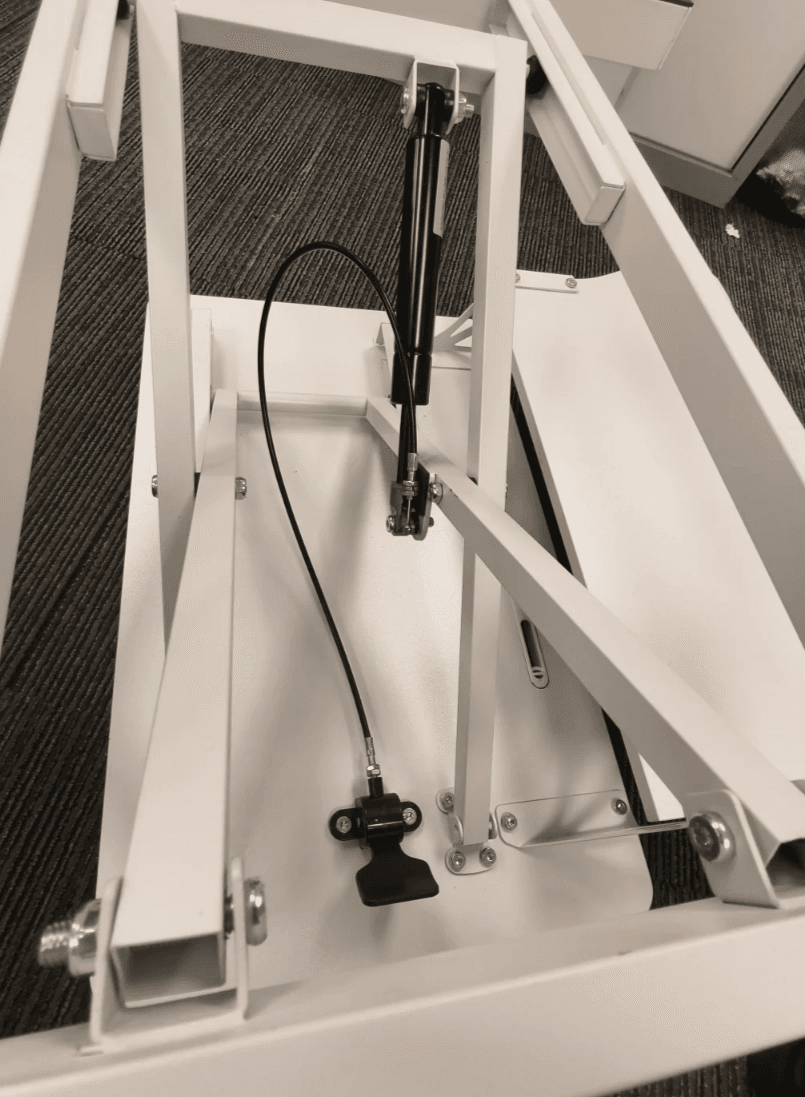
How to Choose a Gas Spring for a Height Adjustable Desk Without Harsh Motion or Sudden Rebound
How to Choose a Gas Spring for a Height Adjustable Desk Without Harsh Motion or Sudden Rebound
Meta Description: Learn how to choose a gas spring for a height adjustable desk by reviewing force, stroke, damping, geometry, and user feel. Avoid heavy push-down force, harsh motion, and sudden rebound.
Introduction
When a height adjustable desk feels wrong, the issue is usually not whether it moves, but how it moves. If the desk rises too fast, rebounds near the top, or feels too heavy when pushed down, users quickly notice. The product may function, but the experience feels unrefined.
That is why choosing a gas spring for a height adjustable desk is not just about matching a force number. The right result depends on the balance between force, stroke, damping, geometry, and real user behavior.
Start With the Motion Problem
In desk development, the most common complaints are:
- the desk feels heavy during downward movement
- the upward motion is too aggressive
- the desk is easy to move in one position but hard in another
- the motion feels unstable near the top or bottom
These problems usually come from poor system matching, not from one single part defect. A gas spring that looks correct on paper can still perform badly once installed in the real structure.
What Causes Harsh Motion or Sudden Rebound
Harsh motion usually means the speed changes too abruptly. The user feels a jump, a stiff zone, or an uncontrolled release. Sudden rebound often happens when the desk becomes overbalanced and rises too quickly after release.
A heavy push-down feeling usually has one of three causes:
- spring force is too high for the real payload
- mounting geometry creates poor leverage
- damping does not match the intended motion feel
This is why adjustable desk gas spring selection must be based on the full application, not only on catalog force.
The 4 Factors That Matter Most
1. Force
Force must support the desk and payload while still allowing comfortable user operation. Too much force makes downward adjustment difficult. Too little force can reduce balance and stability.
2. Stroke
The spring stroke must match the desk travel, but the real motion range also depends on linkage and mounting position. Catalog stroke and actual desk movement are not always the same thing.
3. Damping
Damping strongly affects perceived quality. It helps control speed, reduce abrupt movement, and make lift and push-down feel more consistent. If smoothness is part of the product promise, damping matters.
4. Geometry
Geometry changes user effort. The same gas spring can feel light in one structure and heavy in another. Pivot location, mounting angle, and the desk's center of mass all affect the result.
Why Force Rating Alone Is Not Enough
One common mistake is selecting by nominal force only. The user never interacts with the spring directly. The user interacts with the whole desk system.
For example:
- a high-force spring may still feel acceptable if leverage is favorable
- a moderate-force spring may feel too aggressive if the top position is overbalanced
- a system that works unloaded may feel wrong once monitors or accessories are added
That is why prototypes should be evaluated with realistic loads and real geometry.
How to Tune for Better Ergonomics
If the goal is easy, controlled motion for a wide range of users, selection should focus on user feel, not just lift assistance.
A better-tuned desk usually aims to:
- reduce excessive push force
- avoid sudden acceleration during lift
- keep motion smooth near end positions
- stay balanced across realistic load conditions
- remain usable for lighter users, not only strong operators
This is especially important in dual-leg desks and compact adjustable furniture, where stability and effort need to work together.
Common Selection Mistakes
Several issues appear repeatedly in adjustable desk projects:
- choosing by catalog force only
- ignoring payload variation
- underestimating the value of damping
- testing only with internal engineering staff
- assuming a standard part will automatically deliver premium motion
These mistakes usually lead to rework after prototype assembly, when correction becomes slower and more expensive.
What to Validate Before Finalizing
Before fixing the final specification, test the mechanism under realistic conditions. Review:
- starting force and release feel
- push-down effort across the stroke
- lift speed
- stability near top and bottom positions
- smoothness under different payloads
- consistency across repeated cycles
If possible, validate in the actual desk structure rather than a simplified bench setup.
When a Custom Gas Spring Makes Sense
A standard part may be enough for a basic project, but a custom gas spring is often the better choice when the desk needs premium motion, unusual geometry, broader load variation, or easier operation for a wider user group.
Custom tuning is especially useful when your product promise includes quietness, refined motion, and better ergonomics. In those cases, technical support during selection and prototype review can reduce trial and error.
Conclusion
The best gas spring for a height adjustable desk is not the one with the closest catalog force. It is the one that delivers the right motion behavior in the real product. Good selection depends on force, stroke, damping, geometry, and user expectations working together.
If you want to avoid harsh motion, sudden rebound, and heavy push-down effort, define the motion experience first, then select the spring around the full desk system.
CTA
If you are developing a height adjustable desk, send us your structure, payload range, and target travel. We can help review force, damping, and geometry to determine whether a standard or custom gas spring solution is the better fit.