
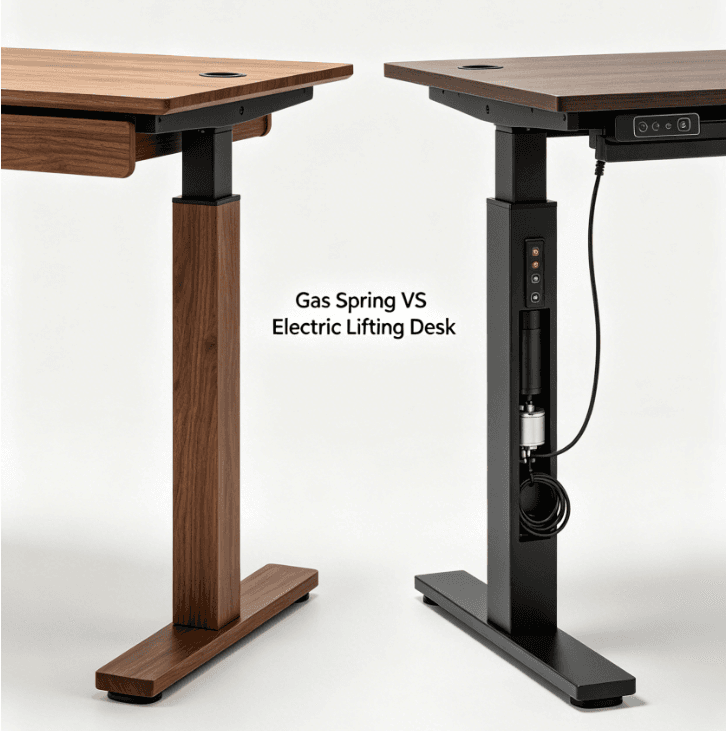
Gas Spring vs Electric Lifting System: Which Is Better for Adjustable Tables and Desks?
Gas Spring vs Electric Lifting System: Which Is Better for Adjustable Tables and Desks?
Meta Description: Compare gas spring and electric lifting systems for adjustable desks and tables. Understand the tradeoffs in complexity, noise, maintenance, user feel, and application fit.
Introduction
When a team develops an adjustable desk or table, one early decision shapes the entire product: should the lifting system be gas spring based or electric?
There is no universal winner. The better choice depends on the product goal, the expected user experience, and the practical limits of the application. Some products need automation and memory presets. Others need quiet, clean, cable-free motion with lower structural complexity.
Start With the Product Goal
Before comparing mechanisms, define what the product must actually do. Useful questions include:
- Does the product need powered adjustment or manual repositioning?
- Is quiet operation important?
- Will the table be moved frequently?
- Is cable-free placement a benefit?
- Is the product selling convenience, or refined simplicity?
These questions matter because the mechanism should support the product concept, not define it by accident.
Where Gas Springs Usually Fit Best
Gas spring systems are often a strong choice when the product needs controlled manual movement with fewer components. In adjustable desks and tables, that can mean:
- no external power requirement
- no cable management
- lower electrical failure risk
- quieter operation
- easier relocation and setup
Gas springs are especially attractive when the product is meant to feel elegant, simple, and easy to use. In some premium concepts, that simplicity is a benefit rather than a compromise.
Where Electric Lifting Usually Fits Best
Electric lifting systems are often better when the product needs features manual systems cannot provide easily. Typical reasons include:
- push-button adjustment
- memory height presets
- high payload support
- very low user effort
- automation as part of the product promise
If those features are central to the project, electric lifting may be the more suitable architecture despite the added complexity.
The Most Important Tradeoffs
Structural Complexity
Gas spring systems are usually simpler. They avoid motors, controllers, power supplies, and wiring. That can reduce packaging and assembly effort.
Electric systems provide more functionality, but they also introduce more integration work.
Noise
If quiet operation matters, gas springs often have the advantage. A well-tuned gas spring mechanism can deliver very smooth, low-noise adjustment. Electric systems can perform well, but they rarely disappear acoustically in the same way.
Maintenance and Failure Risk
Gas spring systems often reduce the number of subsystems that can fail. Electric systems can still be reliable, but they depend on more components, which can make troubleshooting and long-term maintenance more complicated.
User Feel
Gas springs create a more direct, physical interaction with the mechanism. That can feel refined when the motion is properly tuned. Electric lifting offers convenience, but the user experience is machine-driven rather than manually balanced.
Mobility and Use Environment
For products used in flexible spaces, mobile layouts, or environments where power access is inconvenient, gas springs can be a strong fit. Removing cables can improve placement freedom and reduce visual clutter.
Why Gas Springs Can Support Premium Positioning
Many teams assume electric automatically means more advanced. In reality, a gas spring can support a premium position when the value comes from:
- smooth manual motion
- low visual complexity
- quiet use
- easy one-hand adjustment
- cable-free placement
In those cases, the gas spring becomes part of the product story. It helps the table feel mechanically refined instead of electronically dependent.
When Electric Is Clearly Better
A gas spring is not always the right answer. Electric lifting is usually the better choice when:
- users expect automatic adjustment
- loads are consistently high
- accessibility needs favor powered motion
- synchronized lifting of larger structures is required
- interface features are central to the offer
If the product depends on those capabilities, forcing a manual solution can create an inferior result.
Common Comparison Mistakes
Teams often make three mistakes:
- comparing only unit cost instead of total product value
- assuming motorized always means better
- assuming gas springs are suitable only for low-end products
A custom-tuned gas spring system can deliver a highly differentiated result, especially when simplicity, quietness, and motion feel matter more than automation.
How to Make the Decision
A practical decision should review:
- payload range
- frequency of adjustment
- desired user effort
- expected motion feel
- installation environment
- power availability
- maintenance expectations
- target market position
Choose a gas spring approach when you want simpler structure, quieter motion, flexible placement, and refined manual control.
Choose electric lifting when automation, presets, high-load support, and low-effort powered movement are essential.
Conclusion
Gas spring vs electric lifting is not a generic better-or-worse debate. It is a product architecture decision. Gas springs offer advantages in simplicity, quietness, and cable-free flexibility. Electric systems are stronger when automation and advanced control are part of the product requirement.
The right next step is not asking for a part number first. It is defining how the desk or table should behave, then selecting the lifting method that supports that behavior with fewer compromises.
CTA
If you are comparing gas spring and electric lifting concepts for an adjustable table or desk, send us your product concept, payload target, travel range, and use scenario. We can help evaluate which architecture is more practical and whether a custom gas spring solution could create a stronger product.