
Performance Reliability of Hood Gas Struts in Extreme Climates: Environmental Adaptability and Safety Factor Design
Abstract: Explore the mechanism of how extreme climates affect the force values of automotive hood gas struts, deeply analyze performance evolution in extreme cold and heat, and provide a 1.2 to 1.5 safety factor engineering design guide based on industry standards.
In modern automotive body design, the support system of the engine hood not only relates to the convenience of daily maintenance but also directly affects operational safety under extreme weather conditions. Hood struts currently universally utilize gas springs (or gas struts). Their core working principle is to use an inert gas (usually high-pressure nitrogen ) within a sealed cylinder as an elastic medium. The extension and compression of the piston rod change the internal volume, thereby generating a supporting force.
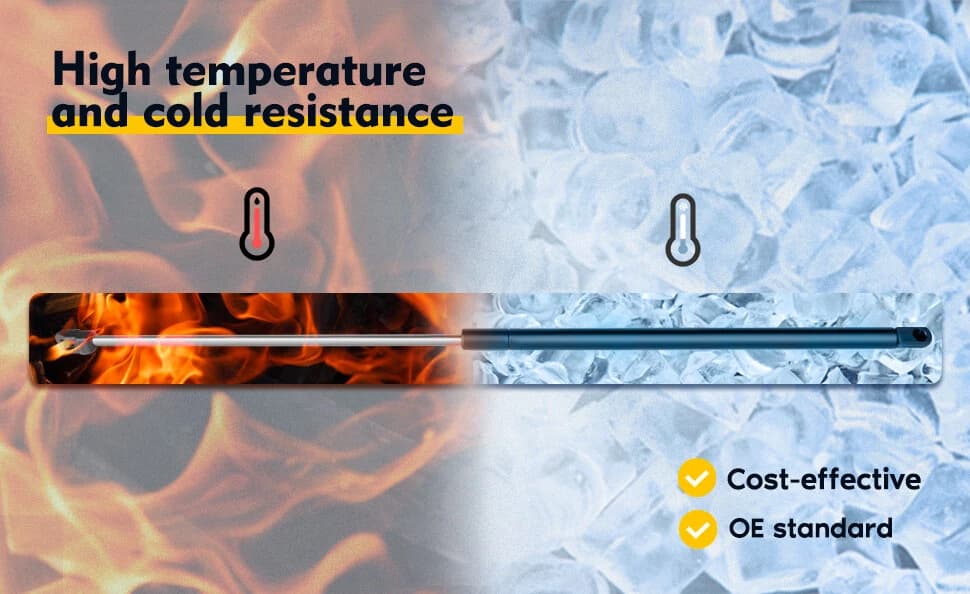
However, as components highly dependent on the physical state of a confined gas, gas struts are extremely sensitive to environmental temperature changes. In extreme climates, whether freezing cold (e.g., to ) or scorching heat (e.g., over due to summer sun exposure combined with residual engine heat), gas struts often face the risk of the hood falling due to force attenuation, or closing difficulties and hinge damage due to force surges. Therefore, studying the influence mechanism of temperature on gas spring force values and ensuring structural reliability through a reasonably designed safety factor (1.2 to 1.5 times) is a crucial topic in automotive engineering.
I. Influence Mechanism and Engineering Quantification of Temperature on Gas Spring Force
1.1 Physical Mechanism and Equation of State
The pressure characteristics inside a gas spring essentially follow the ideal gas law (or more precisely, the van der Waals equation). In a sealed cylinder with a relatively constant volume, the absolute pressure of the gas is directly proportional to its absolute temperature:
When the external ambient temperature changes, the thermal expansion and contraction of the nitrogen gas directly cause fluctuations in the internal pressure , which in turn causes a linear shift in the extension force (often referred to as the force, i.e., the initial compression force when the gas spring is fully extended) acting on the cross-sectional area of the piston rod.
1.2 Industry Consensus and Quantitative Data on Temperature Coefficients
According to the specification standards in the technical manual Gas Springs Technical Information by the globally renowned gas spring manufacturer STABILUS:
- The standard test reference temperature for gas springs is usually set at (293.15 K).
- The industry-recognized empirical formula for temperature influence indicates: For every change in ambient temperature, the output force (extension force) of the gas spring changes by approximately to .
This means that, based on the nominal force value at , the theoretical force value at any temperature () can be expressed as:
1.3 Performance Evolution Analysis in Extreme Climates
Using the above standards, we quantitatively calculate the force fluctuations in extreme climate environments:
- Extreme Cold Environment (, e.g., high-latitude winters): Temperature difference . Force variation rate . That is, at , the actual supporting force of the gas spring is only of that at room temperature. If the original design lacks sufficient redundancy, the engine hood is highly prone to an "unexpected drop" due to its inability to overcome its own gravity moment, causing injury to personnel.
- Scorching Heat Environment (, e.g., summer sun exposure plus engine compartment thermal radiation): Temperature difference . Force variation rate . That is, at , the gas spring supporting force surges to of that at room temperature. This not only greatly increases the manual force and operational burden on the user when closing the hood but also causes tremendous mechanical overload on the hood hinges and sheet metal joints.
💡 Key Takeaway for Beginners : Think of a gas spring like a sealed balloon. When it's freezing cold outside, the gas shrinks, and the strut loses strength—which might cause the hood to fall on your head. When it's scorching hot, the gas expands, making the hood extremely hard to close. Temperature is the biggest enemy of gas springs!
II. Mechanical Balance Equation and Safety Factor Design
In actual vehicle development, the selection of gas springs requires not only considering the attenuation of individual forces but also conducting an overall static mechanical balance analysis combined with the geometric topology, center of gravity shift, and motion trajectory of the hood.
2.1 Mechanical Equation of the Hood Support System
According to the Gas Spring Force Calculator & Sizing Guide published by Firgelli Automations, the simplified static torque balance equation for the engine hood in the open position is as follows:
Where:
- = Total weight of the engine hood (Unit: N)
- = Projected distance from the hood hinge center to the hood's center of gravity (COG) (Unit: mm)
- = Angle between the hood opening degree and the horizontal plane
- = Combined effective output force of all gas springs (Unit: N)
- = Distance from the hinge center to the hood-side mounting point of the gas spring (Unit: mm)
- = Angle between the gas spring axis and the hood mounting surface
Important Note: When calculating extreme low-temperature failures, the left-side gravity moment must be based on the "maximum possible gravity" (e.g., considering extreme weight gain scenarios such as snow or ice accumulation on the hood surface).
2.2 Configuration Logic of the 1.2 to 1.5 Safety Factor (SF)
To cope with the force imbalance caused by temperature mentioned above, industry standards mandate the introduction of a 1.2 to 1.5 Safety Factor () during room temperature design. For global aftermarket distributors, choosing the correct SF tier directly impacts seasonal return rates and inventory turnover.
| Design Safety Factor (SF) | Target Climate & Market | Aftermarket SKU Guide for Global Distributors | DK Factory B2B Support Mechanism |
|---|---|---|---|
| 1.2 - 1.25 | Mild climates / Indoor machinery. Suitable for standard inventory turnover. | ✅ Supports 10 pcs/SKU flexible mixed batch orders | Direct factory wholesale pricing, no minimum quantity stress |
| 1.3 - 1.4 | General outdoor / North America & Europe passenger cars. Overcomes 14% gas contraction at -20°C. Best-selling aftermarket tier. | ✅ 100% Stabilus / Suspa cross-reference matching | Digital force-tested 2-PC sets for OE-spec compliance |
| 1.4 - 1.5 | Extreme cold zones (Canada, Northern Europe) & Heavy-duty trucks. Uses synthetic silicone oil & EPDM seals to eliminate hood-drop claims. | 🛡️ 50,000-cycle fatigue warranty, zero dead stock risk | Factory-direct engineering & blueprint support for bulk procurement |
💡 Key Takeaway for Beginners : Because weather messes with the gas pressure, engineers never use a "just enough" gas spring. Instead, they apply a "Safety Factor." By making the spring 20% to 50% stronger than necessary at room temperature, they ensure the hood stays up even in the freezing winter without being impossible to close in the summer.
III. Reliability Analysis Based on Authoritative Engineering Cases and Industry Standards
3.1 Extreme Cold Failure Engineering Case: The Superposition Effect of Seal Failure and Force Attenuation
- Data/Case Source: Background technical analysis of the Chinese National Intellectual Property Administration (CNIPA) utility model patent CN212359481U "A Highly Adaptable Automotive Gas Spring Structure", and industry testing standard QC/T 207-2021 "Technical Conditions for Automotive Gas Springs".
- Phenomenon and Cause Analysis: In multiple after-sales quality incidents involving SUV hood drops in cold regions (such as Heilongjiang, China, and the Great Lakes region, North America), the failure was not solely caused by gas pressure drop due to "Charles's Law". Standard testing found that traditional gas spring rubber seals (Nitrile Rubber NBR or Fluoroelastomer FKM) cross their glass transition temperature at , losing their original highly elastic state and undergoing hardening and shrinkage, leading to a micro-amount of instantaneous gas leakage. When the temperature drop causes the internal pressure to theoretically drop by , coupled with a dynamic micro-leak causing an additional pressure loss of , the total output force falls below the initially designed times safety margin.
- Rectification Engineering Design: Subsequent solutions raised the design safety factor to , and in the development for severe cold adaptability, the sealing system was replaced with low-temperature Ethylene Propylene Diene Monomer (EPDM) rubber combined with "gas-oil" dual-damping sealing technology, ensuring that the comprehensive mechanical retention force at is not less than of the room temperature design locking force.
3.2 Extreme Heat and Durability Combined Aging Case: Material Fatigue Under High Overload
- Data/Case Source: The academic journal Automotive Technology and Material published "Failure Analysis and Optimization of Hood Gas Springs Based on Extreme Temperature Environments" and STABILUS LIFT-O-MAT series technical standard manuals.
- Phenomenon and Cause Analysis: When the summer engine compartment environment reaches due to severe engine operation, the gas spring force value climbs to of the nominal value due to thermal expansion. At this time, if the vehicle's initial design safety factor is too high (e.g., blindly set above ), the total supporting force will present an exponential overload. Testing shows that during frequent opening and closing hood durability tests under high-pressure conditions at (following the 50,000-cycle test in the QC/T 207 standard), the excessively high reverse resistance causes the user to apply an asymmetrical lateral force to the hood sheet metal when closing it. This directly leads to Lateral Misalignment of the piston rod, which in turn exacerbates the eccentric wear of the guide sleeve and seals. After high-heat and high-pressure cycles, the gas spring leakage rate increases significantly.
- Rectification Engineering Design: The study proposes that the safety factor cannot be magnified infinitely; is the optimal upper cutoff point balancing low-temperature supporting force and high-temperature operational manual force. To further smooth out the impact of the temperature coefficient, the STABILUS LIFT-O-MAT with Strut patent technology can be adopted. This structure integrates the gas spring with an external or internal mechanical helical spring, utilizing the extremely stable temperature adaptability of the mechanical spring (its shear modulus variation between and is usually less than ) to suppress the thermal expansion and contraction of the gas, successfully reducing the temperature sensitivity from to within .
💡 Key Takeaway for Beginners : Extreme weather doesn't just change the pressure; it physically damages the parts. Freezing temperatures harden the rubber seals (causing leaks), and extreme heat bends the metal rods due to excessive force. To build a truly reliable car, manufacturers must use high-tech rubber and smart hybrid designs to fight off the elements.
IV. Conclusion and Engineering Design Guidelines
In summary, the reliability design of engine hood struts in extreme climates is an exact quantitative game between physical natural laws (a force shift) and engineering redundancy. When conducting structural design and component selection, the following design guidelines should be strictly followed:
- Limit Principle of Force Calculation: The static balance must be verified based on (or the target market's extreme low temperature), and the combined output force at this time should retain an absolute net supporting margin of at least times (i.e., the hood will still not drop at this temperature).
- Golden Range of Safety Factor (1.2 - 1.5): For calculation and selection at room temperature (), the safety factor should be locked between . A safety factor of is recommended for cold and snowy regions to leave ample margin for thermal contraction and snow/ice loads; meanwhile, never exceed to prevent overload damage to sheet metal under high-temperature conditions.
- Multi-Physics Coupling Verification: While satisfying the safety factor, it is mandatory to conduct high-low temperature cycles () and no less than 50,000 fatigue durability tests in conjunction with relevant industry specifications (such as domestic QC/T 207-2021 or foreign OEM standards), focusing on monitoring the glass transition of seal materials and high-pressure eccentric wear phenomena.
Choosing the right engineering specification prevents costly after-sales returns. Don't let your business lose money on weak inventory. DK Gas Spring eliminates your risk by engineering lift supports in perfect pairs (2-PC Sets) with matching pressure calibrations. Use our Wholesale Buyer Cross-Reference Program to upload your current procurement manifest and get factory-direct pricing within 12 hours.