
How to Replace a Gas Spring Without a Part Number
How to Replace a Gas Spring Without a Part Number
Not every replacement job starts with a readable label or a clean drawing. In real maintenance, aftermarket, and OEM support work, the old gas spring may have no visible part number, worn-off printing, or no supplier trace at all. That does not mean the replacement has to be guesswork.
If the goal is to replace a gas spring correctly, the real task is to identify the working requirements behind the old part. For engineers, buyers, and maintenance teams, that usually means answering three practical questions: how to identify the gas spring, how to measure it, and how to replace it without creating new fit or force problems.
Why this topic brings real inquiries
People do not usually search this topic out of curiosity. They search because a machine hood no longer stays open, a cabinet lid has lost support, an imported unit needs a local replacement, or a service team needs to restore function fast.
That is exactly why this keyword can attract strong inquiries. The reader is already handling a real replacement task and wants to reduce the risk of ordering the wrong gas spring.
Start with the application, not the missing label
When the part number is missing, many buyers feel blocked immediately. In practice, the old gas spring still provides useful clues. The first step is to identify the spring through the application, not through printed markings alone.
Start with these questions:
- What does the gas spring support: a cabinet door, machine hood, enclosure cover, access panel, seat, or window?
- What is it supposed to do: lift, hold open, counterbalance, or improve opening feel?
- What is failing now: weak lift, excessive force, unstable hold-open, poor fit, or awkward motion?
These answers matter because replacement is not about copying a cylinder. It is about restoring function in the real product. Mapping the exact mechanical function allows technical buyers to bypass obsolete OEM codes entirely. By matching your application footprint against standard geometric baselines, you can source verified gas spring replacement solutions that restore original factory opening velocities and force distribution.
Check the visible construction details
Even without a part number, the old spring still leaves physical clues that can narrow the product family.
Look at:
- tube diameter
- rod diameter
- end fitting type
- mounting orientation
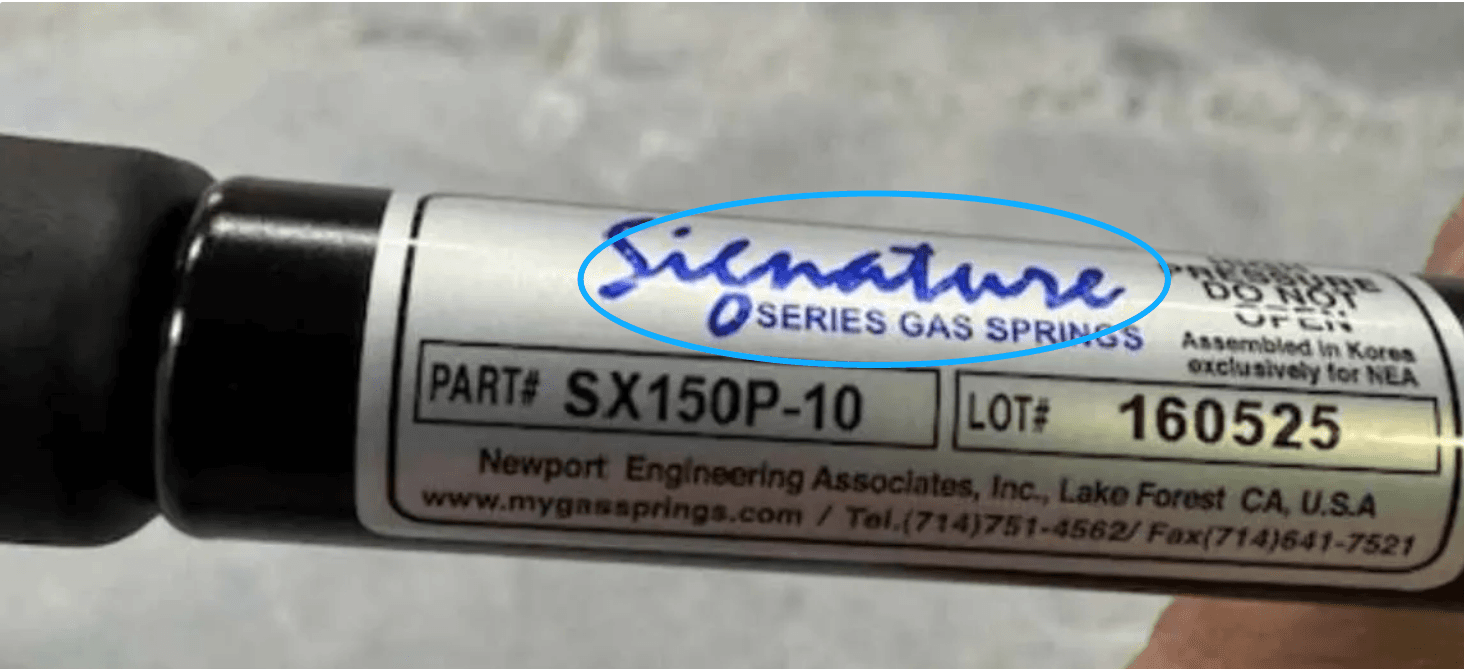
- any visible force number, brand mark, code, or date mark
Those details can often help a supplier narrow the series and replacement range far more effectively than a general photo alone.
Measure the gas spring correctly
If there is no part number, dimensions become one of the strongest replacement references. A supplier can often recommend the correct alternative if the measurements are accurate and the application is clear.
The key dimensions to measure are:
- Extended length: center-to-center distance when the gas spring is fully extended
- Compressed length: center-to-center distance when fully compressed
- Stroke: travel distance between compressed and extended positions
- Tube diameter: outer diameter of the cylinder tube
- Rod diameter: outer diameter of the rod
- End fittings: ball socket, eyelet, clevis, threaded end, or custom fitting
If possible, also record bracket dimensions and ball stud or pin size. A gas spring with similar body dimensions may still fail in assembly if the connection details do not match. Once these exact dimensional boundaries are recorded, most standard industrial setups map cleanly onto a factory-standard catalog. Sourcing pre-calibrated industrial compression gas springs based on these measurements significantly reduces lead times compared to requesting fully customized fabrications.
Do not judge replacement by dimensions alone
Part dimensions matter, but installation geometry matters just as much. If the lid angle, hinge position, or mounting point spacing changed, a spring that looks close on paper may still open too aggressively, fail to hold the load, or interfere during movement.
That is why the safest inquiry includes both part measurements and installed-application photos.
Replace by function, not by appearance
Two gas springs can look very similar and still behave very differently in actual use. That is why replacement without a part number should be based on function, not visual similarity.
Before approving a replacement, check:
- whether the force is suitable for the actual load and geometry
- whether the stroke matches the required motion range
- whether the compressed length fits the closed condition
- whether the end fittings and mounting direction match the design
- whether the spring will work in the same environment, cycle conditions, and temperature range
This is especially important in industrial equipment, access covers, heavy lids, and service panels. “Close enough” dimensions can still create poor user feel, premature complaints, or safety risk.
If a force number is visible, use it carefully
Sometimes the part number is gone, but a force value such as 200N, 350N, or 600N is still visible. That helps, but it is not enough to finalize a replacement by itself.
A visible force value can help with:
- narrowing the likely range
- screening out clearly unsuitable options
- comparing old and new candidates
But it cannot confirm by itself:
- whether the force still fits the real mounting geometry
- whether the old spring has already degraded
- whether the stroke and compressed length are correct
- whether the fittings and brackets will match
In other words, a visible force marking is useful, but it should support the decision, not replace proper measurement and application review.
Common mistakes when replacing a gas spring without a part number
Several mistakes show up again and again in replacement inquiries:
- choosing by appearance only
- using the visible force value as the only reference
- ignoring compressed length and stroke
- overlooking end fitting details
- sending only one photo without measurements
- placing a volume order before validating the part in the real application
This risk is particularly high in vehicle maintenance. Automotive hoods and tailgates require precise end-of-stroke damping profiles to prevent structural stress on the hinges. Guesswork based on visual similarities often fails, making precisely calibrated automotive aftermarket lift supports essential for restoring safe, hands-free operation.
A useful blog should help readers avoid those mistakes before they turn into wrong orders, delays, or field complaints.
What to send for faster replacement support
If you want faster and more accurate feedback, send more than a single photo of the removed spring. A complete inquiry package saves time on both sides and improves the quality of the recommendation.
The most useful inquiry package includes:
- photo of the full gas spring
- close-up of each end fitting
- photo of the gas spring installed in the product
- extended length and compressed length
- tube diameter and rod diameter
- any visible marking, force number, or logo
- application description and load type
- opening angle or target motion
- whether you need an exact replacement or a performance adjustment
- expected quantity and whether you need a sample first
When sample validation is the better path
If the original data is incomplete, sample validation is often the safest path. This is especially true when the gas spring affects user feel, access convenience, opening safety, or production repeatability.
A test sample can help confirm:
- real opening feel
- hold-open stability
- clearance during movement
- fit with existing brackets and fittings
- whether the proposed force is too weak or too strong
For OEM teams and technical buyers, this often makes the difference between a clean replacement project and repeated trial-and-error.
FAQ
Can I replace a gas spring if there is no part number at all?
Yes. In many cases, replacement is still possible if you provide correct dimensions, fitting details, application photos, and any visible force information.
What is the most important measurement to start with?
Start with extended length, compressed length, and stroke. These three values define the motion envelope and quickly narrow the possible replacements.
Can I use a gas spring that looks similar?
Not safely by default. Similar appearance does not guarantee the same stroke, force, fittings, or installation compatibility.
What if I do not know the force?
You can still begin the discussion. A supplier can estimate the likely range based on the application, dimensions, mounting geometry, and load behavior, then refine the choice through sample testing if needed.
Final takeaway
Replacing a gas spring without a part number is usually possible. The key is not finding a visually similar part. The key is identifying the motion, dimensions, fittings, and installation conditions that define how the original spring actually worked.
If you are handling a replacement project now, the best next step is to organize the old part photos, critical dimensions, and installed-condition images. That gives your supplier enough information to recommend a replacement that is much more likely to fit, function, and scale into production.
CTA
If you need to replace a gas spring without a part number, send the old part photos, end fitting details, key dimensions, and installed application pictures. That makes it much easier to judge whether the right path is a dimensional replacement, a functional adjustment, or a sample validation first.