
Understanding Gas Strut Force, Stroke, and Extension
DK Gas Spring: Understanding Gas Strut Force, Stroke, and Extension
At DK Gas Spring, we know that choosing the right gas strut is about more than just size. It is about matching force, stroke, and mounting conditions to achieve smooth, reliable, and consistent performance in real-world applications.
Whether you are designing a cabinet lid, industrial cover, machine access panel, or special-purpose enclosure, understanding the relationship between gas strut force and extension helps ensure better control, longer service life, and a safer user experience.
What Makes a Gas Strut Perform Well?
A gas strut works by using compressed gas inside a sealed cylinder to generate force. That force supports, lifts, balances, or controls movement depending on how the strut is installed and used.
For DK Gas Spring products, the key specifications include:
- Extended length
- Stroke length
- Force rating
- Rod diameter
- Mounting position
These factors work together to determine how the strut behaves throughout its movement. A properly selected gas spring delivers the right support at the right point in the motion cycle, helping your application move smoothly and stay under control.
Force vs. Extension
Gas strut force is not just a single number in theory. In practice, it is closely related to extension length, internal pressure, and the effective area of the piston rod.
A simple engineering relationship is:
Force = Pressure × Area
This means that the force output can be estimated from the internal gas pressure and the piston area. As the strut compresses or extends, changes in gas volume can affect the output force, which is why the behavior across the stroke matters. At DK, we calculate the dynamic forces taking into account the gas temperature expansion coefficient to prevent unexpected failure.
Changes in output force require precise hardware mapping to prevent premature mechanical wear. Engineers specifying standard industrial compression gas springs must account for these pressure differentials, whereas systems requiring rigid mid-stroke positioning rely on valved lockable gas springs to isolate the load.
At DK Gas Spring, we help customers consider not only the nominal force, but also how the strut performs over its full extension range.
Why the Right Specification Matters
Choosing the wrong gas strut can lead to poor performance, excessive wear, or unstable movement. If the force is too low, the application may not open or stay supported properly. If the force is too high, the motion may feel aggressive or difficult to control.
That is why we recommend evaluating:
- Required load support
- Stroke length
- Extended length
- Installation angle
- Mounting geometry
- Temperature conditions
These details help determine the most suitable gas spring for your application and reduce the need for trial-and-error adjustments later. Furthermore, aligning these specifications with stringent quality frameworks—such as IATF 16949 and QC/T 207 standards—ensures that the selected gas spring meets rigorous automotive and industrial performance benchmarks, bridging the gap between theoretical calculations and certified real-world durability.
Trial-and-error adjustments often fail when environmental degradation compromises internal seal integrity. DK establishes strict salt spray endurance baselines for all units, dictating the deployment of stainless steel gas springs or highly sealed marine-grade gas springs in corrosive operational envelopes.
Designed for Reliable Applications
DK Gas Spring products are designed to support a wide range of uses where reliable motion control matters. From lightweight panels to heavier industrial covers, our gas springs are built to help improve usability, reduce manual effort, and create a better user experience.
Because every application is different, our team focuses on helping customers match the right force and dimensions to their specific design requirements.
How to Start the Selection Process
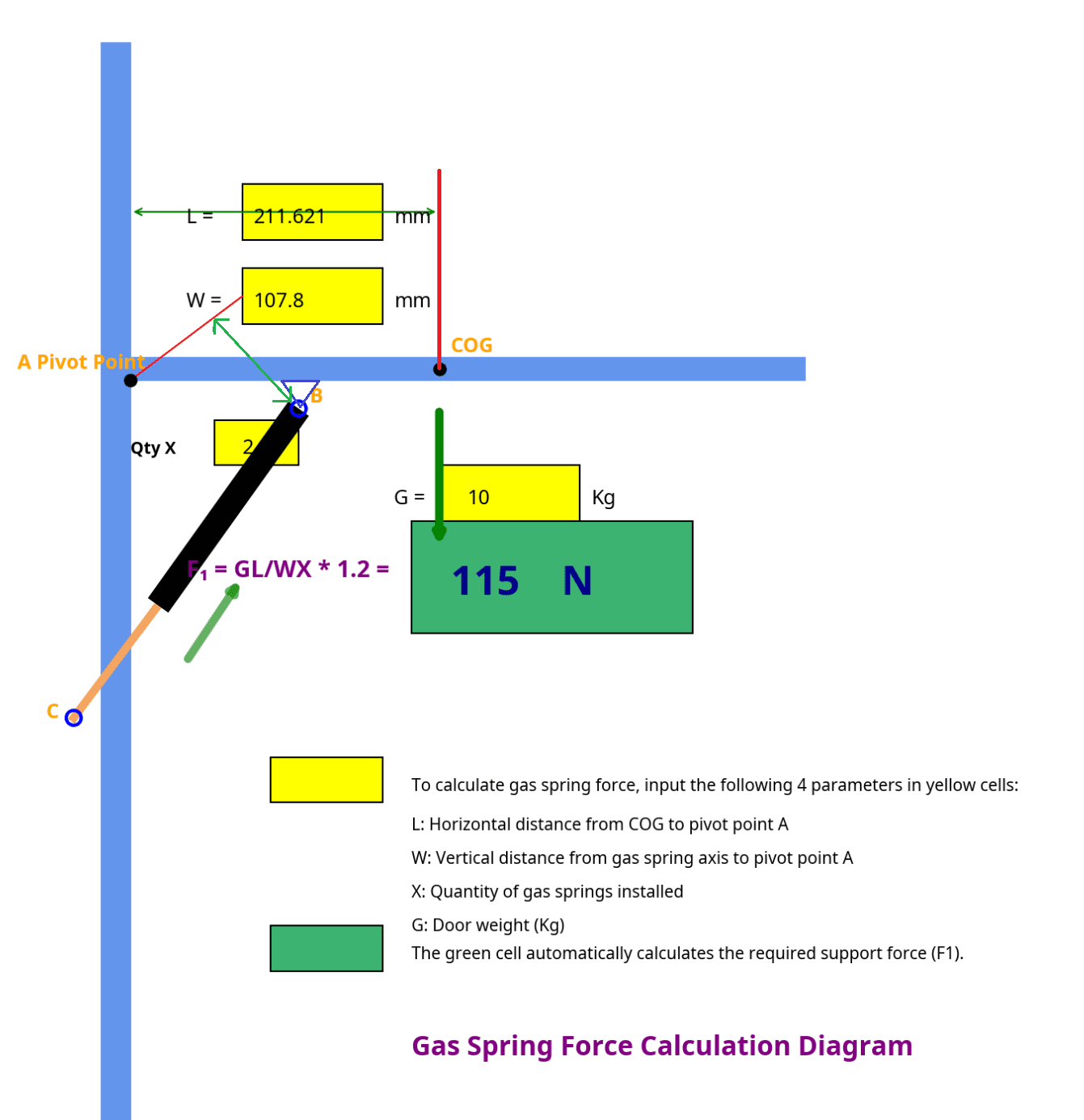
If you are unsure about the exact gas strut force you need, start with the following information:
- Weight of the moving part
- Distance from the hinge to the center of gravity
- Installation points
- Desired opening angle
- Required stroke and extended length
With these details, it becomes much easier to estimate the required force and choose a gas spring that performs well in real use.
Real use damping profiles at the end of the stroke vary heavily based on mounting geometry. The kinematic requirements for heavy-duty commercial vehicle applications differ fundamentally from the controlled descent expected in standard automotive aftermarket lift supports.
Built for Better Motion Control
At DK Gas Spring, our goal is simple: to help customers find gas struts that deliver dependable support, smooth movement, and long-term reliability.
If your application requires precise force control, stable extension behavior, and a solution tailored to your design, a well-selected gas spring can make a significant difference.