
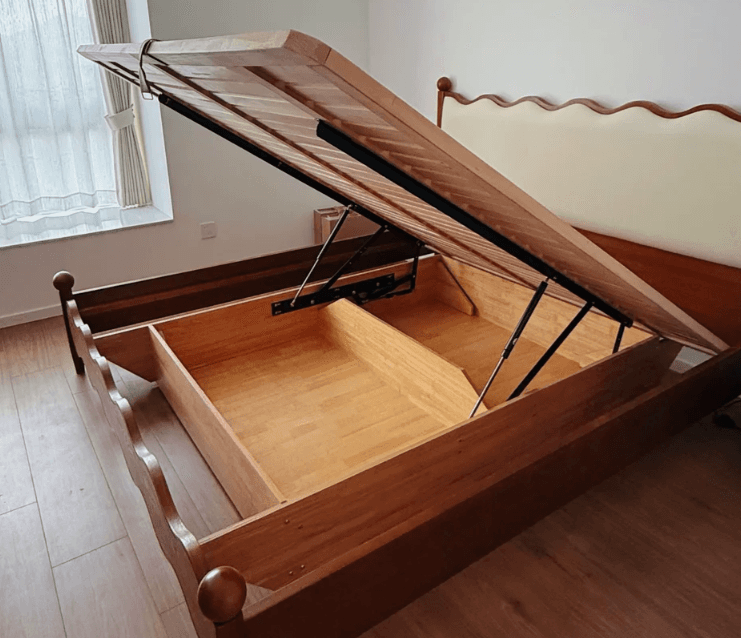
Ottoman Bed Won't Close? Quick Fixes & The Hidden Engineering Cause
Ottoman Bed Won't Close? Quick Fixes & The Hidden Engineering Cause
When a customer assembles a new ottoman storage bed—or upgrades to a new mattress—only to find the lifted bed frame stuck at full extension, refusing to budge no matter how hard they press down, the immediate reaction is to blame a "defective" or "stiff" gas spring.
In reality, gas struts rarely fail out of the box. The true problem lies deeper within the furniture design phase: a fundamental mismatch between the gas spring's force rating (-value) and the actual weight of the mattress and bed frame.
For furniture manufacturers and hardware buyers, this mismatch is more than a minor customer inconvenience. It is a major driver of customer complaints, return logistics, and brand erosion.
This guide provides a quick fix for end users, then breaks down the ergonomics of storage bed resistance, reveals the hidden cost of "one-size-fits-all" hardware sourcing, and explains how engineering-led strut selection and multi-stage damping eliminate post-sale issues.
Quick Fix for Consumers: Try This Before Calling Support
If your gas lift bed is stuck in the open position, try these steps before assuming the gas struts are defective:
-
Put the mattress on first. Gas struts are calibrated for the combined weight of the bed frame plus a mattress. Without the mattress, the upward force of the struts easily overpowers the lightweight frame—leaving the bed stuck open. Slide the mattress onto the platform and try closing again.
-
Press down at the center of the foot end with both hands. Apply firm, even pressure—not at the corners, but at the middle of the bed's front edge. Uneven force at the sides can bind the hinge mechanism, making closure feel impossible.
-
If it still won't close: The bed manufacturer likely used a single high-force gas spring across their entire product line to simplify inventory. When this "one-size-fits-all" strut meets a lighter mattress, the force surplus locks the bed open. This is not a defect—it is a hardware specification error by the manufacturer.
For furniture brands and OEMs, read on for the engineering root cause and how to eliminate this issue in your next production run.
1. The Ergonomics of Bed Closure: Resistance Thresholds
Gas springs operate on a simple principle: high-pressure nitrogen gas sealed inside a cylinder exerts force against a piston rod. However, human force applied at the front edge of a bed frame works through a changing lever arm as the bed swings shut.
When pushing down a storage bed, human effort depends on the net difference between the upward force of the gas struts and the downward gravitational torque of the bed panel plus the mattress.
Ergonomic Resistance Thresholds
-
Comfort Zone (): The downward gravity torque closely matches the gas strut’s upward force. Almost any adult can easily close the bed with one hand, and the frame remains balanced at intermediate angles.
-
Noticeable Effort Zone (): Closing the frame requires two hands and full upper-body exertion. Users experience noticeable pushback near the fully closed position.
-
Lockout Zone (): The upward force exceeds the combined weight by a margin greater than what average adults can manually overcome. Pushing harder risks bending the piston rod, shearing hinge rivets, or fracturing the wooden frame.
When a bed won't close, the gas struts are almost always producing force well inside or above the Lockout Zone.
2. The 30 kg Mattress Weight Variance Gap
Why do bed frames end up in the Lockout Zone? The root cause is the wide range of mattress weights on the market today.
| Mattress Type | Typical Weight |
|---|---|
| Coconut Palm / Fiber | 20 kg |
| Standard Innerspring | 35 kg |
| Memory Foam / Hybrid | 42 kg |
| Heavy Latex / Pillow Top | 50 kg |
Standard 160×200 cm / Queen Size platform. Total variance gap: 30 kg (≈300 N) across the same bed dimensions.
Across a standard (or Queen Size) platform:
-
Thin Coconut Palm / Fiber Mattresses: Weigh as little as .
-
Pocket Spring & High-Density Memory Foam Mattresses: Weigh between and .
This creates a () variance gap on the exact same bed frame dimensions.
The Illusion of "One-Size-Fits-All" Sourcing
To simplify Bill of Materials (BOM) management and reduce SKU counts, furniture factories frequently specify a single high-force gas spring—such as —across an entire bed line.
While a strut holds up a luxury hybrid mattress, pairing that same frame with a lighter mattress creates a force surplus. The end user is left with a bed stuck in the open position.
| Metric | Value |
|---|---|
| Initial BOM Savings (per unit) | ~1.50 saved on bulk hardware |
| Post-Sale Customer Complaints | 15% – 25% of sales units |
| E-Commerce Return Rate | 10% – 15% of delivered beds |
| Total Warranty & Service Cost | 3% – 8% of product retail revenue |
Note: Return rate and complaint statistics are compiled from aggregated B2B client surveys (2023–2025 across EU/NA ecommerce bed frame brands) prior to custom -value calibration.
A slight upfront BOM saving on hardware can quickly be wiped out by service callouts, replacement shipping, and negative online reviews.
3. Climate Effects: Thermal Expansion in Nitrogen Gas
Exporting beds across varying climate zones adds another layer of force fluctuation. Gas struts rely on pressurized nitrogen (), which obeys the ideal gas law (). Internal cylinder pressure changes by roughly for every change in temperature.
| Condition | Ambient Temp. | Force Output (Nominal 600 N Rating) |
|---|---|---|
| Winter / Cold Storage | −20 °C | ~480 N (−20% force reduction) |
| Standard Ambient | 20 °C | 600 N (Nominal rating) |
| Summer / Direct Sun | +40 °C | ~720 N (+20% force increase) |
-
Northern European Winters (e.g., Germany, Poland at ): Cold ambient temperatures reduce gas pressure by up to . Under-specified struts can fail to keep heavy beds open.
-
Southern European Summers (e.g., Spain at ): Internal gas pressure rises by up to . A strut that operates near the force threshold in spring can become locked in mid-summer, pushing the system into the Lockout Zone.
4. Mechanical Kinematics and Structural Risks
Attempting to close a locked storage bed by force leads to predictable mechanical failures.
1. Toggle Position and Dead Points
At maximum opening angles (), the angle between the gas strut axis and the hinge lever arm is narrow. If mounting points are off by even a few millimeters, the mechanism approaches a kinematic dead point (toggle position). At this angle, nearly all downward force is converted into axial compression and side shear, rather than rotational closing torque.
2. Failure Modes under Excessive Manual Force
-
Piston Rod Bending & Seal Scuffing: Side loads deflect the soft carbon steel rods found on low-tier struts. Once bent, the rod scores the internal guide bush, causing gas leaks and total pressure loss.
-
Seal Rupture: Over-pressurization under forced closure tears low-grade nitrile rubber (NBR) seals, leading to rapid oil/gas leakage.
-
Hinge Rivet Shearing: Excessive counter-torque concentrates force onto the hinge assembly, shearing pivot rivets or tearing screws out of wood paneling.
5. Engineering-Led Solutions for Furniture OEM/ODMs
Eliminating closure issues requires a shift from guessing -values to engineering the complete kinematic system.
Precision Torque Calculation Formula
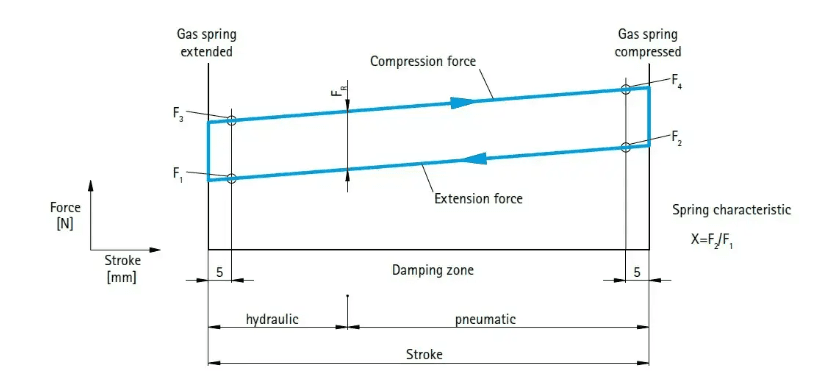
Rather than selecting gas struts based solely on overall bed weight, optimal force calculation uses a complete torque balance equation:
Two-Stage Damping for Smooth, Safe Closing
Modern gas springs feature two-stage hydraulic damping:
-
Main Travel Stage ( Angle): Large internal orifice areas keep hydraulic resistance low, allowing smooth manual lower and hover positioning.
-
Terminal Cushioning Stage ( Angle): As the bed approaches the frame, an internal bypass valve restricts fluid flow. This hydraulic cushion absorbs momentum, preventing slamming, rebound, and finger-pinch hazards.
6. Manufacturing Quality Standards
To withstand years of daily use, storage bed hardware should meet verified industrial standards:
| Test Category | Specification |
|---|---|
| Durability Testing | 50,000+ stroke cycles (<5% force degradation) |
| Corrosion Resistance | Neutral Salt Spray Test (NSS) — ASTM B117 Grade |
| Environmental Safety | SGS RoHS & REACH Compliant Material Sourcing |
-
50,000-Cycle Durability: Tested to ensure force loss remains under after tens of thousands of full extensions.
-
Salt Spray Corrosion Protection: High-grade electroplated or QPQ-treated piston rods withstand humid environments without pitting or rust-induced seal wear.
-
Material Compliance: Full compliance with SGS RoHS standards, ensuring safety for residential indoor spaces.
Frequently Asked Questions
Q: How do we determine the correct -value if we offer 3 different mattress weights?
A: We recommend calibrating to the heaviest mattress in your lineup and applying a thermal safety factor (). For weight gaps exceeding 15 kg between SKUs, dual-force SKU splitting is advised to avoid Lockout Zone issues. Our engineering team provides free force simulation based on your actual mattress specs.
Q: What is the lead time for custom -value sampling?
A: Standard custom samples ship within 7 business days. Expedited 3-day service is available for urgent OEM project timelines.
Q: Can you provide on-site installation training for our assembly line?
A: Yes. We offer remote video guidance and on-site technical support for bulk orders (MOQ: 1,000+ units). Contact our team to schedule a technical session.
References & Standards
- ISO 6508-1 — Metallic materials: Rockwell hardness test for piston rod surface treatment verification.
- SGS RoHS Compliance — Verification reports for industrial steel components (IEC 62321 series).
- ASTM B117 — Standard Practice for Operating Salt Spray (Fog) Apparatus, referenced for NSS corrosion resistance validation.
Partner with Us: B2B Engineering & Custom Strut Sourcing
Resolving post-sale return rates starts with matching gas spring kinematics to your exact bed frame geometry and target mattress weight range.
We support furniture manufacturers, brand owners, and hardware distributors with custom-engineered lifting mechanisms, tailored -value gas struts, and low-MOQ production runs.
What We Provide to OEM/ODM Partners:
-
Free Kinematic Force Modeling & CAD Assistance: Send us your 3D bed frame files or key dimensions, and our engineering team will simulate the complete torque curve to determine the ideal gas strut specs.
-
Custom -Value & Damping Tuning: Tailored stroke lengths, mounting fittings, and force ratings built to match your product lineup.
-
Fast Sampling: Custom evaluation samples produced and shipped in 7 days.
Download Full Technical Spec & Engineering Selection Sheet (PDF)